 Anthony Micallef
Case study · Desktop software
AntonCut
The video editor I built for my YouTube channel, written in Rust.
- export time, same frames343 s → 23 s
- StatusPublic beta, v0.3.1
- Built withRust · egui · wgpu
- My partDesign, research, build, testing
The problem
Editing retro game videos and Shorts in general-purpose editors was slow, and exports could take longer than the video itself.
What I built
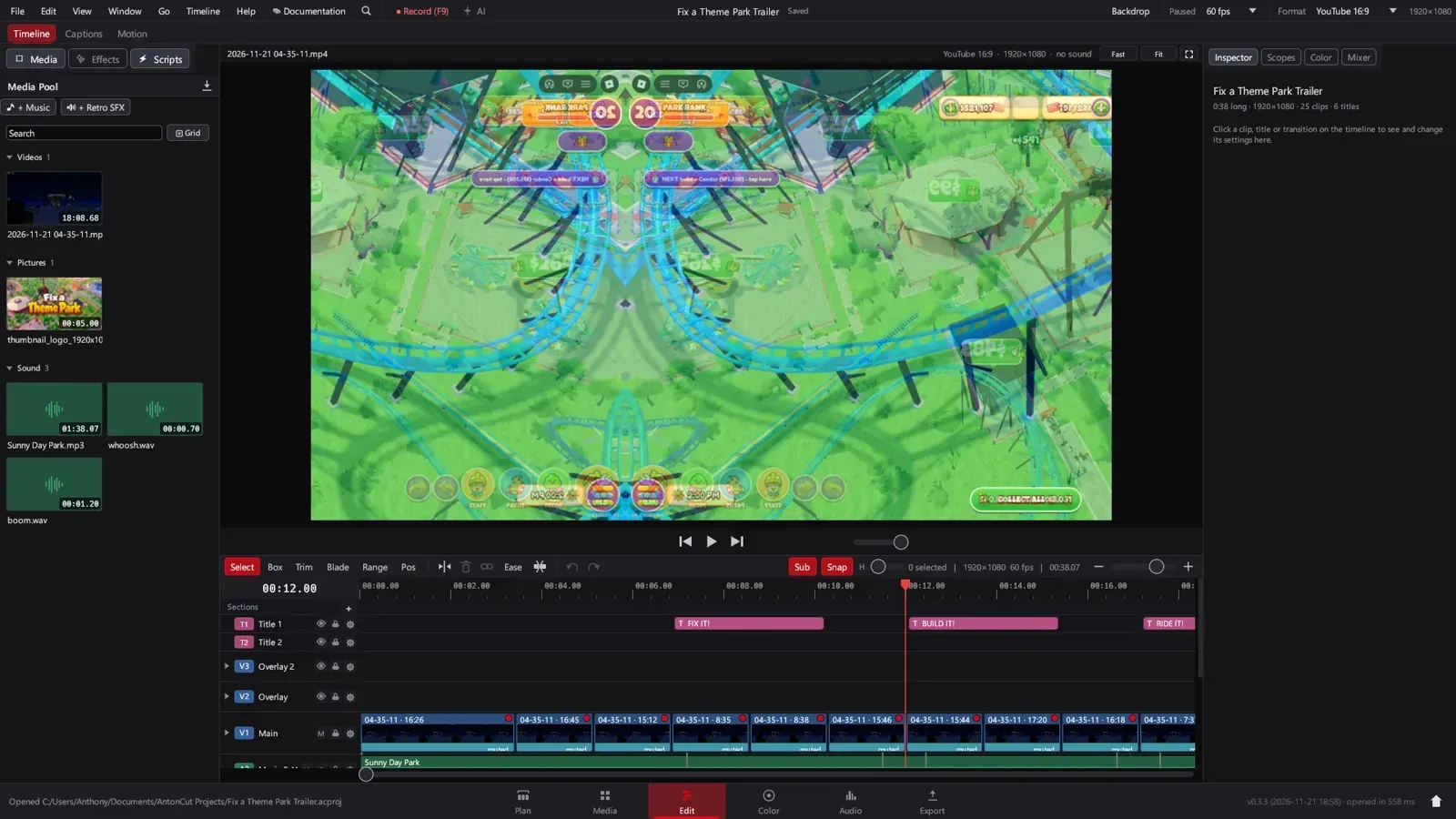
- A multi-track timeline with titles, captions, colour, audio mixing and export
- A GPU preview and an ffmpeg render pipeline
- On-device ONNX models for editing helpers
- An MCP server, so an AI assistant can edit a project while it is open
- Project exchange with DaVinci Resolve through FCPXML
The hard part
Export speed. A 34-second 1080p intro took 343 seconds. I profiled the render graph: the fade filter recalculated every pixel on every frame. Switching to a native fade and the NVENC encoder brought it to 23 seconds with identical frames.
How the work was split
I designed every screen and the editing workflow, tested it on my own videos, and found and fixed the export bottleneck.
AI-assisted programming wrote much of the Rust code, about 80,000 lines across 6 crates.
Result
Exports about 15 times faster, and a public beta I use for my channel.
Stack
What's next
A 1.0 release, with closer DaVinci Resolve round-trips.