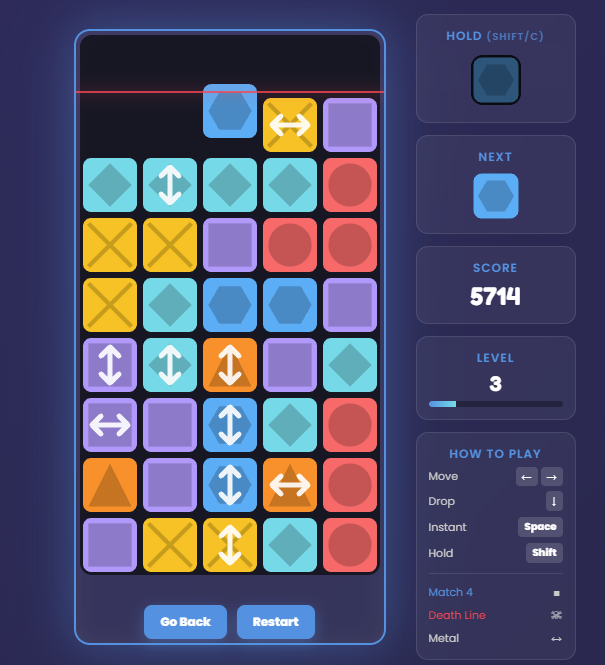
Overview
ClusterCore is a browser-based arcade puzzle game built on Phaser 3. The core mechanic challenges players to clear connected colour clusters on a 7×9 grid, rewarding fast pattern recognition with chain combos and escalating score multipliers. Every session is a short, sharp burst of decision-making under time pressure.
The design brief was simple: ship something that feels like a finished commercial release, not a game jam prototype. That meant tight animations, tuned audio feedback, and a difficulty curve that escalates without feeling punishing.
Gameplay Systems
Players clear clusters of two or more matching-colour tiles by tapping them. The real depth is in chaining: each consecutive cluster cleared within a short window bumps a multiplier, which decays if the player hesitates. High scores require players to read the board several moves ahead, not just react to what is already grouped.
Two special block types add tactical weight to each session. Bombs detonate in a radius, instantly clearing everything nearby. Drills punch straight down through a column, opening new cluster opportunities in a single move. The tension between triggering a special block now versus holding it for a larger chain is the strategic core of ClusterCore.
Technical Implementation
The game runs entirely in the browser with no install. The grid is stored as a flat typed array, making the cluster flood-fill fast enough to run on mid-range mobile hardware without frame drops.
- Phaser 3 game engine with a custom multi-scene architecture
- BFS flood-fill cluster detection on every input event
- Combo multiplier system with configurable decay timer
- Bomb and Drill special block logic with animation callbacks
- REST API integration for global leaderboard submission and retrieval
- Responsive canvas scaling for desktop and mobile viewports
Visual Design
The visual language draws from classic arcade tile games while using a modern dark palette with high-contrast colour clusters. UI chrome is minimal so players can stay focused on the grid. Every colour choice was validated for accessibility contrast ratios to ensure the game is readable across different screen conditions.
What I Learned
Building a game that feels fair at every difficulty level requires more tuning than any single feature. The majority of development time after the core loop was working went into feel: the timing of animations, the decay rate of the multiplier, and the spawn rate of special blocks at each tier. Getting those numbers right is what separates a playable prototype from a game worth sharing.